Creating high-quality practice problems can be challenging, but AI offers a powerful solution. This guide details the process of generating 10 practice problems using AI, covering various subjects and difficulty levels. From defining the scope of the problems to implementing them in a web-friendly format, we’ll explore each step in detail, ensuring clarity and efficiency.
This comprehensive approach will equip you with the knowledge and tools to create a robust set of practice problems tailored to your specific needs. We’ll discuss different AI methods, problem types, and validation techniques to help you craft effective learning resources.
Defining the Scope of Practice Problems
AI can effectively generate a wide array of practice problems, but the quality and suitability depend heavily on defining the scope. This involves specifying the types of problems, the subject matter, difficulty levels, and evaluation criteria. Careful consideration of these factors ensures that the generated problems are engaging, challenging, and truly beneficial for learners.The goal is to create practice problems that encourage active learning and reinforce understanding, not just rote memorization.
The problems should be designed to challenge students’ problem-solving skills and critical thinking abilities. This approach fosters a deeper engagement with the subject matter, leading to improved knowledge retention and application.
Types of Practice Problems
This section details the types of problems suitable for AI generation, differentiating between simple, complex, and open-ended problems. The distinction is crucial for tailoring the problems to specific learning objectives.
- Simple Problems: These problems involve straightforward application of learned concepts. They typically require a single, correct answer, and focus on fundamental skills. For example, in mathematics, simple problems might involve basic arithmetic calculations or identifying geometric shapes. In programming, they could involve executing simple commands or tracing code execution.
- Complex Problems: These problems require students to integrate multiple concepts and skills to arrive at a solution. They may involve multiple steps, multiple variables, or require a more nuanced understanding of the underlying principles. In science, complex problems might involve calculating forces or analyzing chemical reactions. In programming, they could involve debugging or writing functions with multiple parameters.
- Open-ended Problems: These problems do not have a single, definitive answer. Instead, they encourage creative thinking and problem-solving strategies. These problems might require students to analyze a situation, propose multiple solutions, and justify their reasoning. In history, open-ended problems might involve evaluating the impact of a historical event on society. In literature, students might be asked to interpret a literary work from multiple perspectives.
Examples Across Subjects
This section provides examples of practice problems across various subjects to illustrate the different types. These examples highlight the potential of AI to generate problems tailored to specific learning objectives.
- Mathematics: Simple – Calculate 25 + 15; Complex – Solve a quadratic equation; Open-ended – Design a method to determine the optimal route for delivering packages given various distances and delivery times.
- Science: Simple – Identify the chemical formula for water; Complex – Calculate the amount of heat required to melt a specific mass of ice; Open-ended – Analyze the impact of deforestation on local ecosystems.
- Programming: Simple – Write a program to calculate the sum of two numbers; Complex – Write a program to sort a list of numbers using a specific algorithm; Open-ended – Design a program to solve a specific problem related to data analysis.
Desired Difficulty Levels
The difficulty levels for the 10 practice problems should be carefully considered. These levels should progressively increase in complexity, challenging learners without overwhelming them.
- Beginner: Problems suitable for students with foundational knowledge of the subject. These problems require minimal prior knowledge and focus on basic concepts.
- Intermediate: Problems suitable for students with a good grasp of fundamental concepts. These problems require the application of those concepts to more complex situations.
- Advanced: Problems suitable for students with a strong understanding of the subject. These problems require a high level of critical thinking and problem-solving skills.
Evaluation Criteria
The quality of the generated problems needs rigorous evaluation. A well-structured evaluation process ensures the problems are accurate, relevant, and engaging.
| Criteria | Description |
|---|---|
| Accuracy | Problems must be mathematically or scientifically correct. |
| Relevance | Problems should be relevant to the subject matter and learning objectives. |
| Clarity | Problems should be clearly worded and easily understandable. |
| Engagement | Problems should be stimulating and encourage active learning. |
| Difficulty | Problems should match the desired difficulty level (Beginner, Intermediate, Advanced). |
Methods for AI-Generated Problem Creation

Generating practice problems with AI offers a dynamic and scalable approach to educational resources. This method allows for a diverse range of problems, tailored to specific learning objectives, and adaptable to various subject areas. It promises to create a rich and engaging learning experience.AI’s ability to generate practice problems stems from its capacity to analyze and synthesize vast amounts of data, including problem structures, solution approaches, and associated contexts.
By understanding these patterns, AI can produce novel problems while maintaining a consistent level of difficulty and relevance to the curriculum.
Large Language Models (LLMs)
LLMs, such as GPT-3, can be trained on vast corpora of text and code, enabling them to generate problem statements in various formats. This includes mathematical equations, word problems, and even programming challenges. Their proficiency in language understanding allows them to create problems that are grammatically sound and contextually appropriate. A key advantage is their ability to adapt to different writing styles and target audiences.
For instance, an LLM could craft a challenging word problem for advanced math students or a simple one for elementary schoolers.
Knowledge Graphs
Knowledge graphs provide a structured representation of knowledge, connecting entities and their relationships. This structured format allows for the generation of problems that are logically consistent and relevant to specific subject areas. For example, a knowledge graph for physics could be used to generate problems involving forces, motion, and energy. The inherent structure of a knowledge graph ensures the accuracy and consistency of generated problems, particularly in domains requiring precise definitions and relationships.
Data Sets and Algorithms
Leveraging existing datasets is crucial for creating diverse and realistic problems. These datasets can encompass a wide range of information, from mathematical formulas to historical data for social science problems. Algorithms play a critical role in processing and transforming this data into well-defined problems. For instance, algorithms can analyze a dataset of historical events to create problems related to cause-and-effect or decision-making.
Furthermore, these algorithms can be designed to control the complexity and scope of the problems generated, ensuring they align with the intended learning objectives.
Comparison of Techniques
| Method | Problem Statement Generation | Solution Generation | Associated Data | Pros | Cons |
|---|---|---|---|---|---|
| LLMs | Excellent, adaptable to different styles | Limited, often requires refinement | Vast text and code corpora | Flexible, creative, potentially diverse problems | Potential for inaccuracies, logical inconsistencies |
| Knowledge Graphs | Strong, logically consistent | Potentially limited to specific types of problems | Structured knowledge representation | Accurate, relevant, high control over problem domain | May struggle with open-ended problems, limited creativity |
| Data Sets and Algorithms | Diverse, potentially real-world scenarios | Dependent on data, may require significant refinement | Various data types (numerical, textual, historical) | Realism, scalability, controlled complexity | Data quality issues, potential biases in data |
Content Structure and Formatting
Organizing practice problems effectively is crucial for a user-friendly learning experience. A well-structured format enhances comprehension and allows learners to focus on the problem’s core elements. This section details how to create a structured and responsive table to display practice problems, ensuring a clear presentation of problem statements, hints, solutions, and difficulty levels.
Table Structure for Practice Problems
A well-organized table format enhances the presentation of practice problems. This structure allows for clear separation of problem statements, hints, solutions, and difficulty levels. The table is designed to be responsive, adapting to different screen sizes.
| Problem Statement | Hints | Solutions | Difficulty Level |
|---|---|---|---|
| Problem 1 statement | Hint 1, Hint 2 | Solution steps | Medium |
| Problem 2 statement | Hint 1, Hint 2 | Solution steps | Easy |
This structured table format allows for easy navigation and comprehension of each problem, making the learning experience more efficient.
Using HTML table elements, you can create a responsive table that dynamically adjusts to various screen sizes, ensuring accessibility for all users.
Formatting Problem Statements
The problem statement is the core of each practice problem. Different problem types require different formatting strategies.
- Word Problems: Use clear and concise language to describe the scenario. Include all necessary information for the problem to be solvable. Use headings for different parts of the problem (e.g., “Given,” “Find”). For example, a word problem might read: “A farmer has 100 chickens and 50 ducks. How many more chickens does the farmer have than ducks?”.
- Multiple-Choice Questions: Present the question clearly, followed by a list of options using `
- ` or `
- London
- Paris
- Berlin
- Rome
- `. Ensure options are concise and unambiguous. Example: “What is the capital of France?
“.
- Coding Challenges: Present the problem clearly, and provide any necessary input or constraints. Include the desired output. Format the problem statement using paragraphs and code blocks to show expected input and output, as well as the required language. For example, a coding challenge might specify: “Write a function that calculates the sum of two numbers and returns the result.
Input: Two integers. Output: The sum of the two integers”.
Optimal Use of HTML Elements
Utilizing HTML elements for formatting and presentation significantly improves readability and understanding.
- Headings (h1-h6): Use headings to structure the problem statements, breaking down complex problems into smaller, more manageable parts. For example, you might use an
to denote a word problem or a
to denote a specific part of a coding challenge.
- Paragraphs (p): Use paragraphs to present the problem statement, hints, and solutions clearly and concisely. Maintain logical flow within each paragraph.
- Lists (ul, ol): Use unordered or ordered lists to present multiple-choice options, steps in a solution, or bullet points in hints. Ensure clarity and proper formatting for each list item.
- Code Blocks (pre, code): For coding challenges, use code blocks to display code snippets and clearly highlight the code structure.
Problem Types and Considerations
AI can effectively generate diverse practice problems across various subjects and skill levels. Careful consideration of problem types, difficulty levels, and desired learning outcomes is crucial for creating impactful learning materials. This section delves into different problem types suitable for AI generation, along with strategies for fostering critical thinking and problem-solving skills.
Generating practice problems that encourage critical thinking and problem-solving is a key goal. Effective problem design should move beyond simple recall and application, prompting students to analyze, evaluate, and create solutions. AI can be instrumental in crafting problems that challenge learners to apply knowledge in novel situations.
Identifying Suitable Problem Types
Different problem types cater to various learning objectives and cognitive skills. Understanding the characteristics of each type is essential for crafting effective practice problems. Problem types can be categorized as straightforward recall, application-based, analytical, or creative.
- Recall Problems: These problems assess the ability to remember facts, definitions, and formulas. AI can easily generate multiple-choice or fill-in-the-blank questions based on provided knowledge bases. For instance, recalling the capital of a country or defining a mathematical term.
- Application Problems: These problems require applying learned concepts to solve practical scenarios. AI can generate problems involving the application of formulas, principles, or theories in context. Examples include calculating the area of a triangle or determining the solution to a physics problem using Newton’s laws.
- Analytical Problems: These problems demand deeper analysis and interpretation of information. AI can generate problems that involve identifying patterns, drawing conclusions, or evaluating evidence. Examples include interpreting data from a graph or drawing conclusions from a case study.
- Creative Problems: These problems encourage students to generate novel solutions or approaches to problems. AI can generate open-ended questions or scenarios that stimulate creativity. Examples include designing a solution to a societal problem or creating a story based on a specific theme.
Designing Problems for Critical Thinking
Problems should be designed to encourage critical thinking by requiring students to analyze, evaluate, and synthesize information. This involves prompting learners to justify their answers, consider alternative perspectives, and evaluate the validity of assumptions.
- Multi-step Problems: These problems require learners to apply multiple concepts or procedures to reach a solution. This promotes a deeper understanding of the underlying principles involved.
- Open-ended Problems: These problems don’t have a single correct answer, prompting students to develop their own reasoning and justification. This fosters creativity and problem-solving skills.
- Scenario-based Problems: These problems present a real-world or hypothetical situation, requiring students to apply knowledge to a specific context. This fosters a deeper understanding of practical applications.
Input and Output Variations
Diverse input and output formats enrich the learning experience.
- Text-based Problems: These problems use textual descriptions, questions, and scenarios. AI can generate problems involving reading comprehension, summarization, or analysis of complex texts.
- Numerical Problems: These problems involve calculations, estimations, or data analysis. AI can generate problems involving arithmetic, algebra, geometry, and statistics.
- Image-based Problems: These problems involve interpreting or analyzing images. AI can generate problems requiring the identification of objects, patterns, or relationships within images. For instance, analyzing charts or graphs.
Categorizing Problems
The following table categorizes problems by type, difficulty, and subject. This framework helps in organizing and tailoring practice problems for specific learning objectives.
| Problem Type | Difficulty Level | Subject |
|---|---|---|
| Recall | Easy | History |
| Application | Medium | Mathematics |
| Analytical | Hard | Science |
| Creative | Very Hard | Literature |
Problem Validation and Refinement

Ensuring the accuracy and quality of practice problems is crucial for effective learning. AI-generated problems, while potentially efficient, require careful scrutiny to guarantee they are suitable for the intended purpose. This process involves rigorous validation, error identification, and refinement to improve the overall learning experience.
Validating the generated problems for accuracy and completeness is a multifaceted process. It requires a deep understanding of the subject matter and the intended learning objectives. The initial step involves verifying the mathematical or logical correctness of the problem statements. Subsequent steps include examining the solutions and ensuring they align with the problem’s structure. Careful attention to detail is paramount.
Methods for Validating Accuracy
A comprehensive approach to validating the accuracy of generated problems involves multiple checks. These include employing automated verification tools to identify potential errors in calculations and logical inconsistencies. Manual review by subject matter experts is essential to ensure the problem aligns with the curriculum and expected learning outcomes. This human review can capture nuanced errors and subtleties that might be missed by automated systems.
For example, if a problem involves interpreting a graph, a human expert can assess the clarity and appropriateness of the presented data.
Identifying and Correcting Errors
The identification of errors in generated problems requires a systematic approach. This includes analyzing the generated problem statements for logical fallacies, mathematical inconsistencies, and any ambiguity that could lead to misinterpretation. The identification process often involves the use of automated tools for error detection and manual review to ensure the quality of the problem’s construction. For example, a problem asking for the area of a circle might incorrectly use the formula for the perimeter.
Error correction involves carefully rewriting the problem to eliminate inconsistencies and provide clear, unambiguous instructions.
Strategies for Refining Problem Quality
Improving the quality of generated problems hinges on incorporating feedback from various sources. This involves gathering feedback from instructors and students to identify areas for improvement. Student feedback can provide insights into the clarity and difficulty of the problems. Instructor feedback can help refine the problem’s alignment with learning objectives. For example, if multiple students struggle with a particular problem’s wording, that phrasing should be revised for greater clarity.
This iterative process is crucial to ensure the generated problems are engaging and effective.
Evaluating Problem Difficulty and Adjusting
Determining the appropriate difficulty level for practice problems is essential for maximizing learning outcomes. A problem that is too easy will not challenge the student, while a problem that is too difficult may discourage them. Evaluation methods for problem difficulty include using statistical analysis to identify the problem’s complexity relative to the student population. This analysis could involve examining the time students take to solve the problem and the frequency of correct answers.
For example, if a significant portion of students find a problem too challenging, the problem should be adjusted to improve accessibility. This might involve breaking down complex problems into smaller, more manageable steps.
Example Implementation
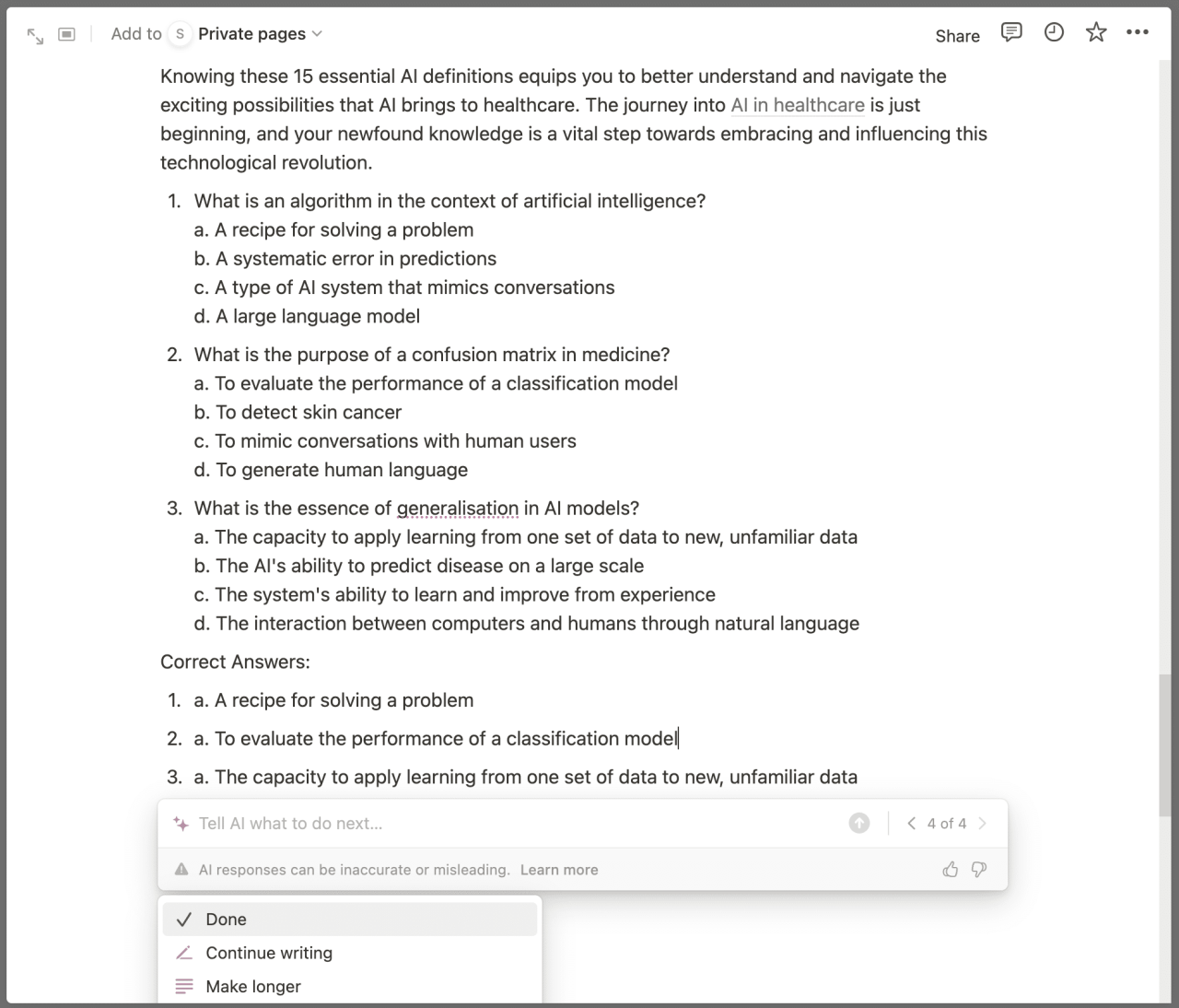
Generating practice problems with AI requires a structured approach. This section provides a concrete example of 10 practice problems, showcasing the implementation details, content, and formatting suitable for a web browser. The problems cover diverse subjects and difficulty levels.
This sample set demonstrates how AI-generated problems can be effectively presented, aiding in student understanding and assessment. The structure, formatting, and inclusion of problem types are designed to enhance user experience and facilitate effective learning.
Sample Practice Problems
This section presents a sample set of 10 practice problems, demonstrating the structure, content, and formatting suitable for display in a web browser. The problems are designed to cover diverse subjects and difficulty levels.
- Mathematics (Basic Algebra)
-Level 1 : Solve for x in the equation 2 x + 5 = 11. - Mathematics (Geometry)
-Level 2 : Calculate the area of a triangle with a base of 8 cm and a height of 12 cm. - Science (Physics)
-Level 1 : A car accelerates from 0 to 60 mph in 8 seconds. What is the average acceleration? - Science (Biology)
-Level 2 : Explain the process of photosynthesis, including the reactants and products. - History (US History)
-Level 1 : Name three significant events that occurred during the American Revolution. - History (World History)
-Level 2 : Describe the causes and consequences of the French Revolution. - English Literature (Shakespeare)
-Level 1 : Identify the main characters in Shakespeare’s Hamlet. - English Literature (Modern Fiction)
-Level 2 : Analyze the theme of alienation in a novel, such as “The Stranger” by Albert Camus. - Computer Science (Basic Programming)
-Level 1 : Write a Python program to calculate the sum of the first 10 natural numbers. - Computer Science (Data Structures)
-Level 2 : Explain the difference between a stack and a queue data structure, including their applications.
Problem Formatting
The following table demonstrates the HTML structure used to format the problems, including titles, subject matter, level, and problem statements.
| Subject | Level | Problem Statement |
|---|---|---|
| Mathematics (Basic Algebra) | Level 1 | Solve for x in the equation 2x + 5 = 11. |
| Mathematics (Geometry) | Level 2 | Calculate the area of a triangle with a base of 8 cm and a height of 12 cm. |
The use of appropriate HTML elements ensures clear presentation and accessibility for users. The structured approach facilitates easy identification of problem type and difficulty level.
Ultimate Conclusion
In summary, this guide provides a structured approach to generating 10 practice problems with AI. By understanding the scope, methods, structure, problem types, validation, and implementation, you can leverage AI to create engaging and effective learning materials. The examples and tables provided will streamline the process, allowing you to quickly build a comprehensive practice set. Ultimately, this approach empowers educators and learners to optimize the learning experience.